•
5 min read
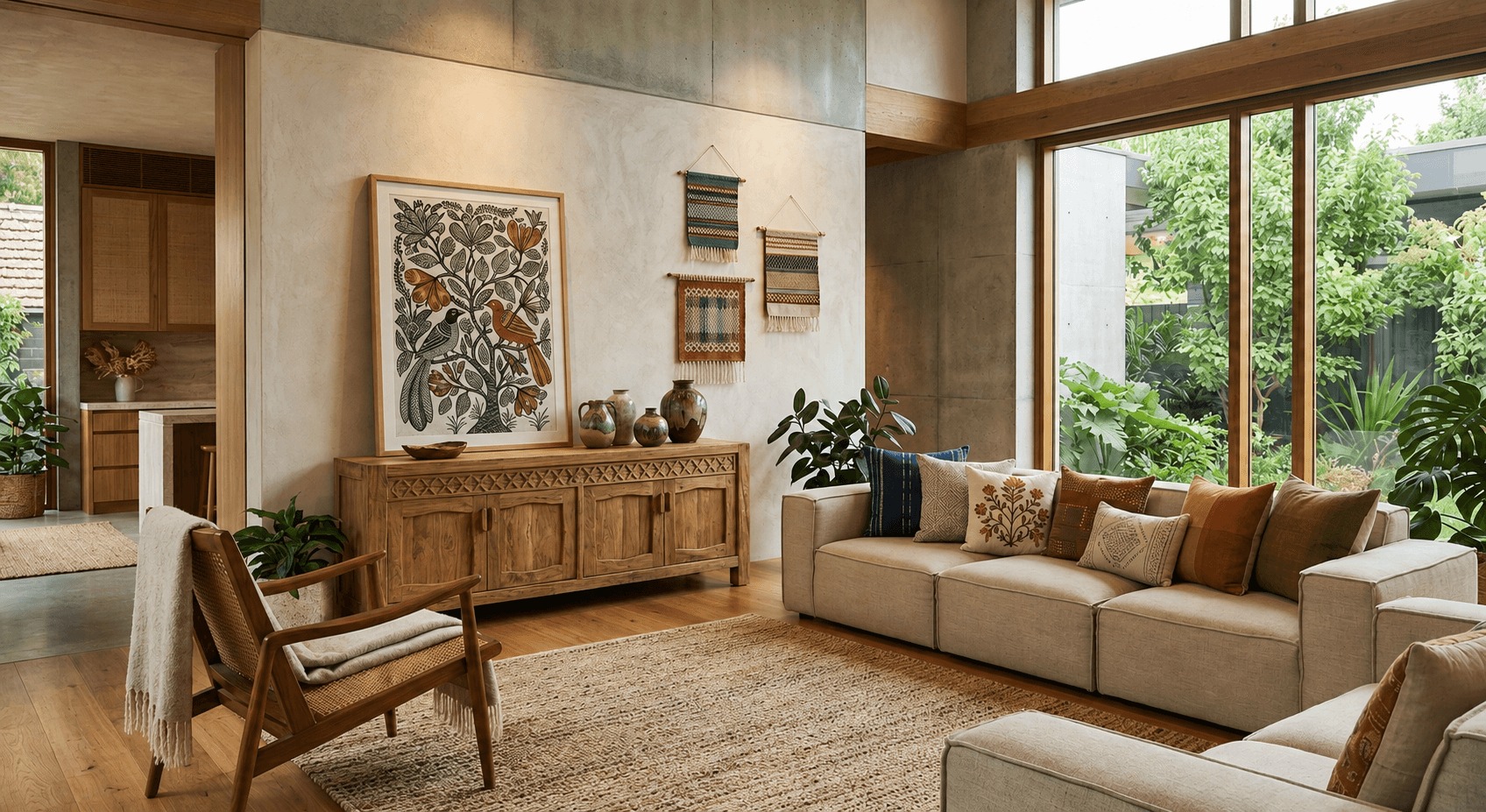
At Xception the Design Studio, we have spent decades observing how homes evolve alongside the people who inhabit them. And quietly, almost imperceptibly at first, a design revolution has unfolded inside the modern Indian home.
For years, the aspiration was clear: perfection through coordination.
Matching sofa sets. Matching curtains. Matching dining chairs. Matching laminates.
A home that looked polished, predictable, and complete.
It was a language of safety — one where luxury was often measured by abundance. More ornamentation. More carving. More grandeur. More display.
But today, the conversation has changed.
The modern Indian home is no longer trying to resemble a showroom frozen in perfection. Instead, it is becoming something far more personal: a layered reflection of identity, memory, restraint, and emotional comfort.
What we are witnessing is the rise of a new design philosophy — one that balances Essential Minimalism with Soulful Heritage.
The Shift From “More” to Meaning
The new Psychology of the Modern Indian Home
Traditional luxury in Indian interiors was often rooted in visual richness. Heavy furniture, ornate detailing, velvet upholstery, glossy finishes, and decorative excess were considered markers of success.
But modern homeowners — especially younger Indian families and global professionals — are seeking something deeper.
They want calm. They want warmth. They want authenticity..
What we are witnessing at the studio is not merely a design trend. It is a psychological shift.
The old design brief often sounded something like this:
“I want my home to look like I’ve made it.”
The emphasis was external validation. A home designed to impress.
But the conversations today feel profoundly different.
Now, clients tell us:
“I want my home to feel like me.”
That distinction changes everything.
Modern Indians are balancing two identities simultaneously.
They are global in exposure yet deeply rooted in culture.
They appreciate the clean efficiency of Scandinavian or Japanese-inspired minimalism, but they do not want to disconnect from the emotional warmth of Indian living.
They want comfort without coldness. Function without sterility. Elegance without performance.
The new Indian aesthetic is not about stripping a home of personality. It is about creating intentional space so that every object, texture, and memory carries meaning.
Minimalism provides the canvas. Heritage provides the soul, here is how
1. The Power of the “Hero Piece”
One of the strongest shifts we see in contemporary Indian homes is the move away from fully coordinated furniture sets.
Instead of filling every corner with decorative elements competing for attention, modern interiors now revolve around carefully chosen focal points — what we call the “Hero Piece.”
Imagine entering a living room designed with understated elegance:
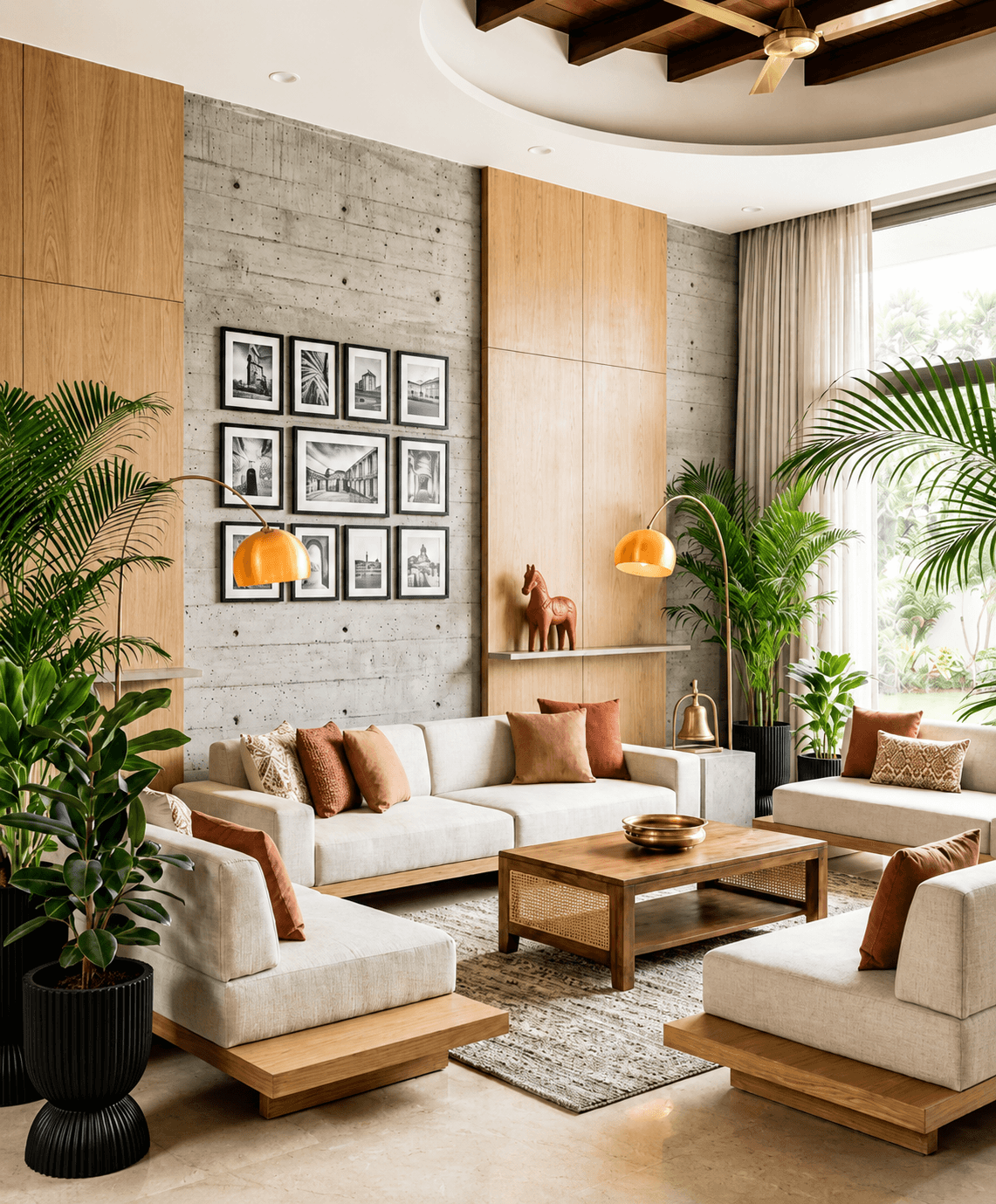
Low-profile grey sofas. Soft ambient lighting. A muted earthy palette. Clean architectural lines.
And then — anchoring the entire room — a single hand-carved teakwood chest inherited from a grandparent. Or perhaps a striking Gond-inspired artwork. Or an antique brass temple bell suspended in an otherwise contemporary setting.
That single element immediately transforms the room.
Why?
Because restraint creates attention.
When visual noise is reduced, craftsmanship becomes visible. Heritage becomes emotional. Objects gain presence. The hero piece is no longer just décor. It becomes narrative.
This is where modern Indian design differs from global minimalism. We do not believe in sterile emptiness. We believe in emotional anchors. A thoughtfully curated home should contain moments that pause you. Moments that remind you where you come from.
2. Textural Depth Over Loud Color
Another defining characteristic of the new Indian aesthetic is the move away from overwhelming color saturation.
For years, richness was associated with bold palettes — maroons, golds, dark woods, and heavily patterned surfaces layered together.
The irony is that we, as Indians, are naturally gifted at this. Our childhood homes were masterclasses in layering—Varanasi weaves, ancestral wood carvings, and modern electronics all sharing the same square footage. We’ve always known how to mix; we just needed to stop calling it "cluttered" and start calling it "considered."
A home that matches perfectly is easy to buy, but a home that is layered requires the courage to be vulnerable. It requires choosing your own personality over a trend.
Today, sophistication is increasingly being expressed through texture instead of excess color.
Neutral, earthy tones now dominate modern Indian interiors:
Warm greys. Muted beiges. Soft whites. Terracotta undertones. Natural wood finishes.
But simplicity does not mean flatness.
The richness emerges through tactile contrast.
The Modern Layer
• Matte black fixtures
• Micro-concrete flooring
• Fluted glass partitions
• Seamless cabinetry
• Soft architectural lighting
The Traditional Layer
• Hand-knotted wool rugs
• Raw silk drapes
• Cane-back chairs
• Handwoven textiles
• Brass accents aged with time
The beauty lies in the interplay.
3. The Rise of the “Un-Matchy” Philosophy
Perhaps the most exciting evolution in Indian interiors is the rejection of perfectly coordinated spaces.
Matching once represented security.
Today, individuality matters more.
Homeowners are increasingly embracing what we call Curated Layering — a thoughtful blending of styles, periods, materials, and memories.
This is where design becomes deeply personal.
A Japandi-style console may become the backdrop for an ancestral brass urli.
A contemporary dining space may feature vintage wooden chairs collected over time.
Minimal pendant lighting may coexist beautifully with Kondapalli toys displayed on open shelves.
A neutral modern bedroom may suddenly come alive through embroidered Indian flora-and-fauna motifs on cushions or textiles.
None of these combinations are accidental. And importantly, they are not chaotic. They are intentional contrasts.
The modern Indian home is beginning to look less like a catalogue page and more like a visual autobiography. Layered. Collected. Evolving.
The goal is no longer perfection. The goal is authenticity. Because the most beautiful homes rarely look finished. They look inhabited.
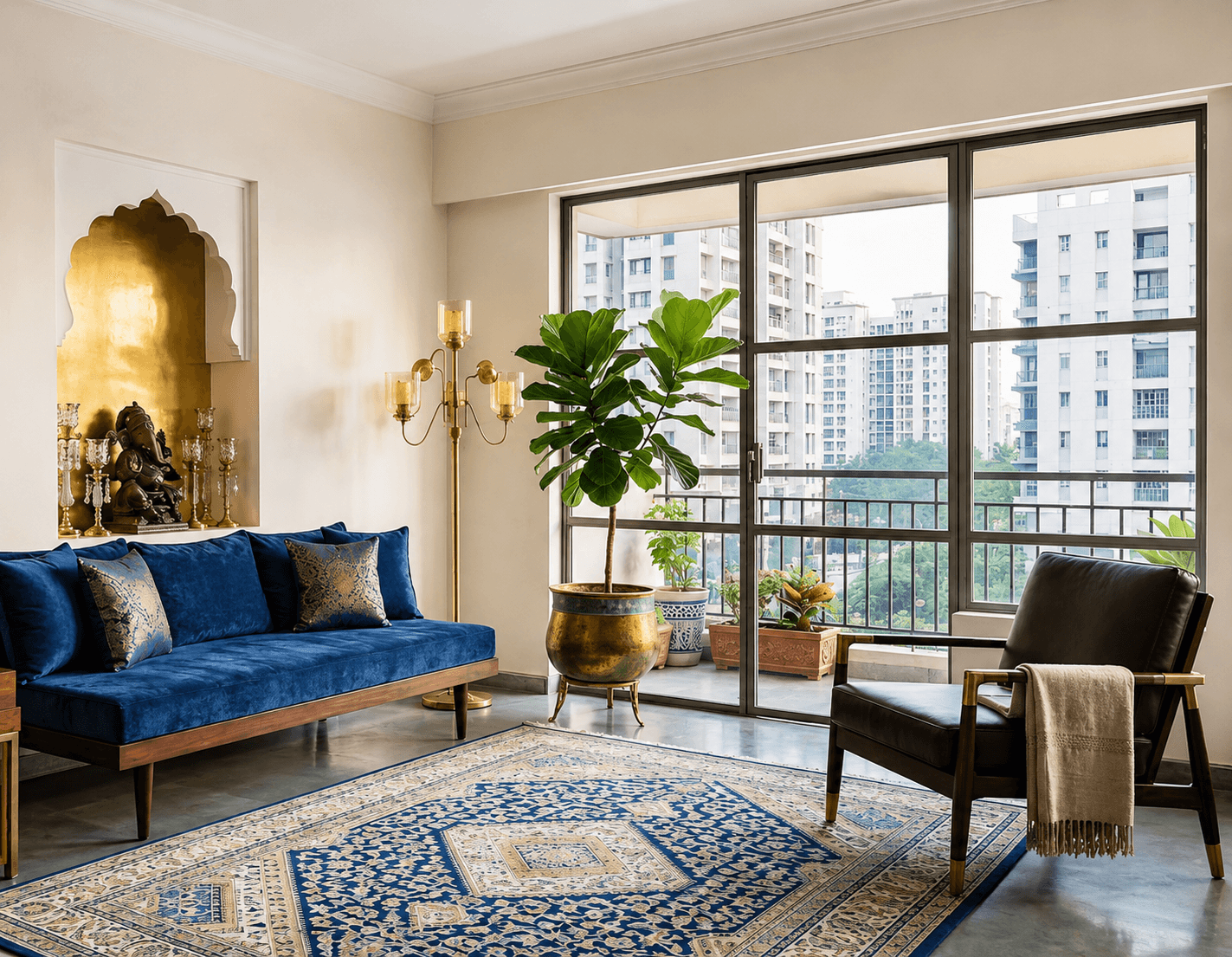
They may admire a sleek Muuto lamp beside a handcrafted Indian textile. They may prefer clean architectural geometry softened by handcrafted details.
This duality is not contradiction. It is evolution.
The modern Indian home no longer chooses between contemporary and traditional. It thoughtfully blends both.
Designing for “Modern Heritage”
At Xception the Design Studio, we believe the future of Indian interiors lies in balance.
A well-designed home should feel light, never burdened. Minimal, yet emotionally rich. Contemporary, yet rooted.
This philosophy influences every layer of our work. Because true luxury is not excess. True luxury is clarity.
It is a home where every element has purpose. a A home where silence, comfort, and memory coexist beautifully, a home that continues evolving with the people inside it.
We do not simply design rooms. We curate legacies.
We take the beautifully contradictory parts of modern life — the global influences, inherited memories, contemporary aspirations, and cultural roots — and weave them into spaces that feel deeply personal.
Spaces that feel collected over time. Spaces that feel effortless. Spaces that feel like home.
If you are ready to move from matching to meaningful, from decorated to deeply personal, we would love to help you create a home that feels unmistakably yours.
Ready to Begin Your Design Journey?
#XceptionDesign #ModernIndianHome #MinimalistTraditional #InteriorDesignIndia #LivedInLuxury #HeritageDesign #CuratedInteriors
More Insights